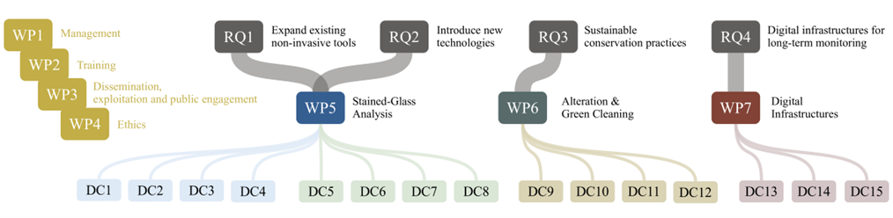
The project structure consists of 4 non-research work packages (WP1-4) and 3 interconnected research WPs (WP5: Novel detection techniques; WP6: Innovative green conservation methods; WP7: New Digital Infrastructures), covering all aspects including management (WP1), training (WP2), dissemination, exploitation and public engagement (WP3), ethics (WP4) and research (WP5-7).
WP1 - Coordination and management
Lead: VUB
Objectives:
1. To coordinate and manage the Glass-Care project
2. To ensure efficient implementation of activities
3. To smoothen collaboration among WPs
4. To oversee day-to-day operations
WP2 - Career training
Lead: UNL
Objectives:
1. To provide high-quality research training to DCs
2. To expose DCs to interdisciplinary learning opportunities from academic, industrial and private partners within an international environment
3. To equip DCs with the knowledge, skills and competencies necessary for a successful career in the conservation sector, academia or industry
WP3 - Communication, dissemination, outreach
Lead: VUB
Objectives:
1. To communicate & disseminate Glass-Care’s results to the scientific & conservation communities and the public
WP4 - Ethics
Lead: SNM
Objectives:
1. To oversee all ethical aspects of the project
2. To raise awareness about ethical aspects concerning stained-glass materials and conservation methods
3. To ensure FAIR data management and open access
4. To prevent misconduct
WP5 - Development of novel stained-glass analysis techniques
Lead: FORTH
DCs involved: DC1-DC8
Objectives:
1. To develop 8 validated protocols for an advanced understanding of materials, technology and structural stresses for stained-glass analysis
2. To employ established portable methods (UV-Vis-NIR, p-XRF, Raman and fluorescence spectroscopy, MSI, HSI) and 3 new innovative techniques
3. To deliver 3 demonstrator set-ups (Demo1: photoacoustics, Demo2: ptychographic microscopy, Demo3: multimodal tomography) and one database
WP6 - Development of green conservation methods
Lead: UPEC
DCs involved: DC9-DC12
Objectives:
1. To develop eco-friendly monitoring, cleaning and reconstruction protocols, targeting glass alteration including biofilm control and the replacement of toxic materials
2. To develop a portable setup for biofilm monitoring
3. To establish a reference database on green reconstruction materials
WP7 - Development of digital infrastructures
Lead: NTNU
DCs involved: DC13-DC15
Objectives:
1. To create an integrated digital framework for stained-glass heritage by combining multimodal sensing, Machine Learning and digital twin technology
2. To deliver a validated multi-sensor data fusion platform, a ML model for automated condition assessment and a digital twin prototype
3. To test and validate these tools on at least 10 stained-glass windows and develop the associated end-user protocols